






First up is Dr Dani Diaper, head of our Medicine pathway, who teaches future doctors, scientists and healthcare professionals. She is a published scientist in high-ranking academic journals and textbooks who has spoken at international conferences on topics as important as motor neuron diseases and dementia. A STEM ambassador too, Dr Diaper is also known to school students outside of UFP, giving career talks on science and neuroscience. She graduated from King’s College London and Bath University, joining UFP in 2018.
What degrees do you have and where did you graduate from?
I have an undergraduate degree, a BSc (Hons) in Molecular and Cellular Biology, from Bath University. A couple of years after that I enrolled on a masters, an MSc in Neuroscience at King’s College London. After getting a distinction in my masters, I was offered a PhD placement at King’s to look into the molecular neuroscience underlying motor neuron disease and FTLD, a type of dementia.
What were you doing before you joined UFP?
Before joining UFP, I was a post-doctoral researcher trying to understand the disease mechanisms of motor neuron disease and FTLD. This job involved designing experiments, lab research, data analysis and collaborations with other clinical research groups. I was also responsible for supervising final year undergraduate and postgraduate students doing their lab projects and dissertations.
Can you remember your first time in a science lab?
Yes, I did some work experience at a factory that made sterile medical and research supplies. I spent the summer holidays working in the microbiology and tissue culture labs – I was so excited to be there. I loved the practical, hands-on aspect of it and also completing reports for my supervisor, who then used that information to make sure that the products met the high standards for sterile equipment. I remember being amazed that you could grow human cells so easily in a dish in the lab!
Why did you decide to start teaching?
While working as a post-doc, I realised that one aspect of the job I really enjoyed was the time spent with students guiding them on their lab work and project write-ups. We would sit and have lengthy discussions about what their data meant and how to improve their research. It was always satisfying when a concept clicked for a student; we would be poring over their data, looking to apply our knowledge to their data set, and then you would see their face light up and eyes widen as suddenly things made sense to them.
What’s the most rewarding part about your job?
It’s that ‘ah-ha’ moment. Perhaps a student has been stuck on a particular topic or concept for a while and it’s my job to try to find different ways of explaining it. When the pieces come together and the student looks really proud of themselves for having persevered, that feels great.
What’s so special about the UFP Medicine pathway?
For all the modules that the students take, the teachers focus on knowledge application. This means not just learning the topics, but really understanding them and being able to use that knowledge to work out the answer to a problem. All through the minor and major modules, the different teachers are all really committed to helping students do the best they can.
What kind of qualities do you hope to see in your students?
Commitment and a pro-active attitude to learning. Students who are prepared to put in the necessary hard work are always rewarded. And being friendly too – it’s always a much more enjoyable class when there’s a sea of friendly faces!
Can you describe some of the exciting lab work that students get to experience on this foundation?
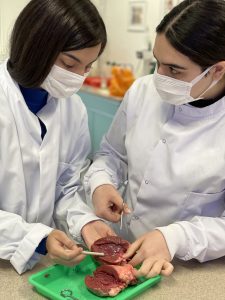
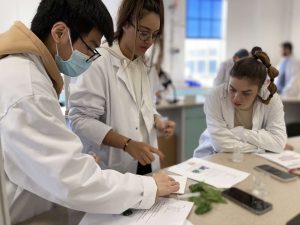
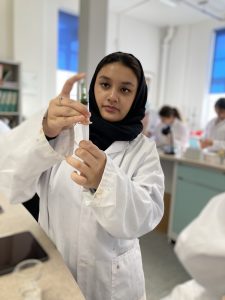
A really popular lab is the heart dissection. We dissect a mammalian heart and look at the different structures and how they suit the job that they do, their function. When learning biology, so many of the images that we draw knowledge from are nice, neat illustrations. But by doing the heart dissections, we see that the reality is not as neat and tidy as the drawings!
What are the most challenging parts of this course?
It is very intensive. Occasionally, I see students who think that UFP is an easy option. It’s not – it’s equivalent to A-Levels, so it’s a lot of hard work. And it’s delivered within a year, so right from the start students have to knuckle down and start revising. To make sure that students are keeping up with the syllabus, we have frequent progress tests, exams and written coursework.
For students who want to become doctors, will they learn everything they need to know to prepare them for medical school?
I hope so! During the first three months, we really focus on applying to medical school, writing a solid personal statement and exploring a student’s motivation for wanting to become a doctor. We look at current medical affairs, ethics, the issues facing the medical world and spend time understanding the healthcare system here in the UK (the NHS). The aim of the first term is to support students to perform their best at interview. In the second and third terms, we focus more on anatomy, physiology and pathology.
What about students who don’t want to be doctors – can they still join the Medicine pathway?
Certainly! In fact, one of the things we discuss in this course is the many different roles in healthcare and the kind of skills you need to work in this area. The topics that we cover in medicine would be of interest to anyone wanting to go on and study a degree in a healthcare-related field, such as physiotherapy, occupational therapy and biomedical sciences.
Where’s your favourite place near the college campus to go for a quiet moment?
Well, I cycle into work, which takes about 40 minutes, so that’s my quiet time really. Once I get to the cycle paths on the back roads, away from the traffic lights and car horns, I get the chance to reflect on the day. Or mentally re-organise my ‘to do’ list!
What are your three favourite things about London?
Ooh, only picking three things, that’s tough! I love the range of museums and galleries, from the big ones such as the Science Museum and the Tate to the smaller hidden gems. And also the access to global cuisine; whichever type food you feel like, there will be a restaurant serving it somewhere in London. It’s like travelling the world for the cost of a tube fare! Finally, there are some really special green spaces and parks that you can escape to in London. Did you know that London is the largest urban forest in the world – it’s officially a forest?!
Which scientist do you most admire and why?
Carol Grieder, who co-won the Nobel Prize in Physiology or Medicine in 2009 for her work on telomeres and the enzyme telomerase, which are linked to cancer and ageing. She actually had a tough time at school, with low grades and poor college entrance scores. It turns out she had dyslexia so had to work out a more creative way of learning and had to persevere to make it to university. She’s a fantastic scientist, who carries out robust research, and is committed to making her lab a supportive place to work.
Tell us something people might not know about you.
I once took part in the Cold Water Swimming World Championships in Finland. A large swimming pool had been cut into a frozen-over lake and we had to race from one end to the other. The air temperature was around -10C and we weren’t allowed to wear wetsuits, but you could wear a bobble hat.
Find out more about the UFP Medicine pathway and which universities you can progress to here.
Here at the University Foundation Programme, we are very pleased to announce our latest university offers our students have received so far.
Read moreWelcome to our ‘Meet the teacher’ series, where we interview different UFP staff to find out more about them and what goes on with their foundation courses.
Read moreStart a new chapter in 2025 – September is the best time to start a foundation course.
Read moreAs the Engineering and Computing sector continues to grow globally, with technical skills becoming invaluable in a world ruled by computer systems, the demand for competent engineering and computing graduates has never been greater.
Read more

Your pathway to over 90 universities, including the prestigious Russell Group.

© Copyright UFP 2025. All rights reserved


© Copyright 2025. All rights reserved

